
When Illinois Law Requires You to Report a Minor Crash
Key Takeaways: In many cases, you don’t have to report an Illinois car accident with $1,500 or less in property damage, but there are important exceptions. Under 625 ILCS 5/11-407, the threshold drops to $500 if any vehicle involved is uninsured. Any injury or death requires a report no matter how small the damage, and so does a crash involving a school bus that causes any damage or injury. When a report is required and no officer comes to the scene, drivers must notify police right away under 625 ILCS 5/11-407. Since Public Act 102-0560 took effect on August 20, 2021, private motorists in Illinois are no longer required to file a separate written Illinois Motorist Report with the Illinois Department of Transportation within 10 days of the crash, as that requirement now applies only to state employees driving state vehicles. Damage on modern vehicles is often underestimated, so a crash that looks minor may still cross the reporting threshold. Failing to notify police when required can lead to a license suspension and may weaken a later injury claim. Notifying police promptly, getting prompt medical care, and preserving evidence can all help protect your ability to pursue compensation.
In many cases, you may not have to report an Illinois crash with $1,500 or less in property damage, but important exceptions apply. Under 625 ILCS 5/11-407, the threshold drops to $500 if any vehicle involved is uninsured. Any injury or death also triggers the reporting duty, no matter how small the damage, and so does a crash involving a school bus that causes any damage or injury. Because injuries often show up hours or days after a collision, a crash that looks minor at the scene may still trigger Illinois’s crash reporting requirements. If you were hurt, properly documenting the crash can also become important evidence in a later injury claim.
If you were injured in a crash and aren’t sure what to file or how to protect your claim, Trapp & Geller can help. Call (312) 368-1444 or contact us now to discuss your situation.
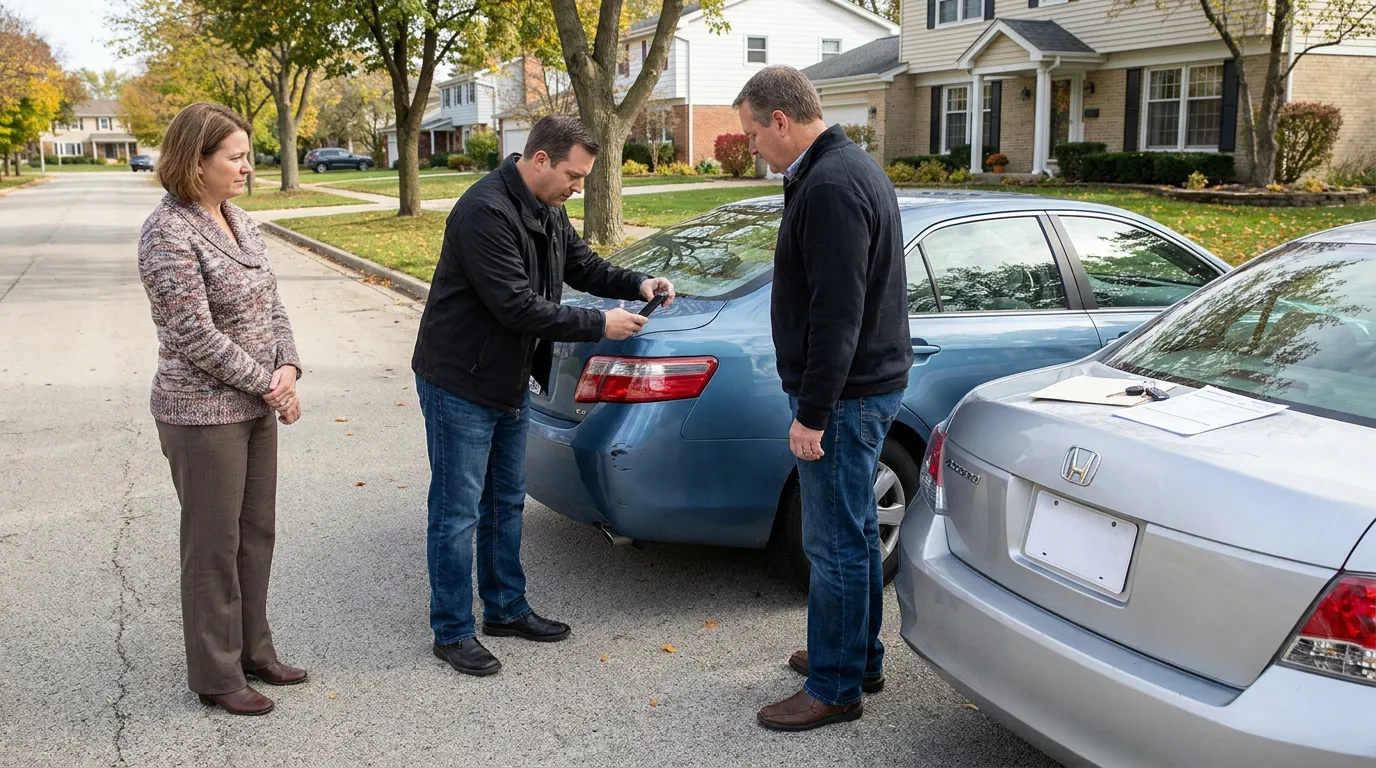
Understanding the $1,500 Crash Reporting Threshold in Illinois
The $1,500 crash reporting threshold in Illinois comes from the Illinois Vehicle Code, not from insurance company policy. Under 625 ILCS 5/11-407, a driver generally must report a crash that falls into any of the following categories:
- The crash injures or kills anyone
- The crash causes more than $1,500 in damage to the property of any one person, including the driver ($500 if any vehicle involved is uninsured)
- The crash involves a school bus and causes any property damage, injury, or death
- The crash happens within 50 feet of a school bus and injures or kills someone getting on or off the bus
You can read the full text of the Illinois crash notice statute on the Illinois General Assembly website. The reporting duty applies no matter who caused the crash. Even a driver who was rear-ended at a red light may have to report.
The $500 Uninsured Vehicle Exception
The threshold drops to $500 when any vehicle in the crash is uninsured. Under 625 ILCS 5/11-407, this applies to vehicles subject to Section 7-601 that have no liability policy. A crash causing $800 in damage may fall below the general limit but still require a report if the other driver had no insurance.
This exception matters to injured drivers. If the at-fault driver was uninsured, you may need to pursue an uninsured motorist claim through your own policy. Promptly notifying police can help document that the other driver lacked coverage. Many policies also require prompt notice to police or the insurer in hit-and-run or uninsured motorist cases.
Why Damage Estimates Can Be Misleading
Repair costs on modern vehicles often run much higher than drivers expect. A cracked bumper can hide damaged sensors, cameras, or structural parts. A crash that looks like $700 at the scene may cost well over $1,500 once a body shop inspects the car. When in doubt, many drivers report the crash to be safe.
How Reporting Duties Work Under the Illinois Vehicle Code
Illinois separates the duty to notify police at the scene from the duties that follow afterward. The Illinois Vehicle Code, 625 ILCS 5/11-401 through 11-408, covers duties after a crash. These include stopping at the scene and exchanging information (625 ILCS 5/11-401 and 11-403), giving immediate notice to police when no officer is present (625 ILCS 5/11-407), and officers who respond forwarding their completed crash reports to the Illinois Department of Transportation (625 ILCS 5/11-408).
Notifying Police When No Officer Is at the Scene
If no officer is present at a reportable crash, 625 ILCS 5/11-407 requires the driver to notify police right away by the fastest available means. Inside a city or village, that means the local police department. Outside city limits, it means the county sheriff’s office or the nearest Illinois State Police headquarters.
If the driver is physically unable to give notice, the duty may shift to someone else. Under 625 ILCS 5/11-407(b), another occupant of the vehicle who is able to report the crash must do so. This can apply when a driver is taken from the scene by ambulance.
The Written Report Requirement
625 ILCS 5/11-406, which once required drivers in a reportable crash to file a written report with the Illinois Department of Transportation within 10 days, was repealed by Public Act 102-0560, effective August 20, 2021. Private motorists in Illinois, including in Chicago, are no longer required to file a separate written Motorist Report with the state after a reportable crash; that obligation now applies only to state employees driving state vehicles. If police investigate at the scene, officers who complete a crash report must still forward it to the Illinois Department of Transportation within 10 days under 625 ILCS 5/11-408. Drivers remain responsible for giving immediate notice to police under 625 ILCS 5/11-407 when no officer is present at a reportable crash.
Filing an Illinois Motorist Report After a Car Accident
Although private motorists are no longer required to file a written Illinois Motorist Report with the state since Public Act 102-0560 took effect on August 20, 2021, you can still file one voluntarily online at motoristreport.illinois.gov if you want an official record of the crash. The Illinois State Police also publishes official forms and instructions on its crash reports page. After you submit, it can take up to 24 hours for the state to assign a control number to the report.
Chicago drivers have an additional free resource. According to the Chicago Police crash card, you can get the other driver’s information through CPD’s online Driver Information Exchange at crash.chicagopolice.org, using the RD number and the crash date. This can help if you couldn’t exchange information at the scene because you were hurt.
💡 Pro Tip: Keep a copy of any report you file and your control number with your medical records and repair estimates. Having everything in one place can make it easier to respond to insurance requests.
| Situation | Report Generally Required? | Authority |
|---|---|---|
| Damage over $1,500, all vehicles insured | Yes | 625 ILCS 5/11-407 |
| Damage over $500, any vehicle uninsured | Yes | 625 ILCS 5/11-407 |
| Any injury or death | Yes | 625 ILCS 5/11-407 |
| School bus involved, any damage or injury | Yes | 625 ILCS 5/11-407 |
| Damage of $1,500 or less, no injury, all insured, no school bus | Generally no | 625 ILCS 5/11-407 |
Consequences of Skipping a Required Property Damage Report in Illinois
Not notifying police when required after an Illinois crash can lead to administrative consequences. Under the Illinois Vehicle Code, the Secretary of State may suspend the license of a driver who fails to give the immediate notice required under 625 ILCS 5/11-407 when no officer responds to a reportable crash. That process is separate from any civil lawsuit over the crash.
Skipping a required notification may also weaken an injury claim. Insurance adjusters often look for gaps in the record to argue that a crash was too minor to cause real harm. Timely notification to police, together with prompt medical care, can help tie your injuries to the collision.
Protecting Your Injury Claim After a "Minor" Crash
Even low-damage collisions can cause whiplash, concussions, and soft-tissue injuries. Property damage doesn’t always reflect how much force your body absorbed. Insurers may use low repair bills to argue that you couldn’t have been hurt, so careful documentation matters.
Early evidence preservation can make a big difference. Photos of the scene, witness contact information, dashcam or nearby surveillance footage, and medical records can all help establish negligence, causation, and damages. Surveillance video may be erased within days. Our guide on what to do after an accident walks through practical next steps.
💡 Pro Tip: Before giving a recorded statement to the other driver’s insurer, consider getting legal guidance. Offhand comments such as "I feel fine" can later be used to dispute your injuries.
Talking with an experienced Illinois motorist report car accident lawyer may help you determine whether your crash was reportable and how to pursue full compensation. Every case depends on its own facts, including insurance coverage, the extent of your injuries, and how fault is disputed.
Frequently Asked Questions
1. Do I have to report a crash with no injuries and $1,000 in damage?
Generally, no, as long as every vehicle involved was insured and no school bus was involved. If any vehicle was uninsured, though, 625 ILCS 5/11-407 lowers the threshold to $500, so a report would be required.
2. How long do I have to file an Illinois motorist report?
Since Public Act 102-0560 took effect on August 20, 2021, private motorists in Illinois are no longer required to file a separate written Illinois Motorist Report with the state; that requirement now applies only to state employees driving state vehicles. Drivers must still give immediate notice to police under 625 ILCS 5/11-407 when no officer is present at a reportable crash, and notifying promptly helps preserve accurate details.
3. Does fault affect whether I must report?
No. The reporting duty applies no matter who caused the crash, so injured victims may also have to report.
4. What if I was too injured to report the crash?
Under 625 ILCS 5/11-407(b), another occupant of your vehicle who is able to notify police must do so. If you couldn’t give notice because of your injuries, notify police as soon as you can, and keep the medical records that show why the notice was delayed.
5. Is the motorist report the same as an insurance claim?
No. Any motorist report you choose to file is a voluntary state filing, separate from insurance claims and personal injury lawsuits, which have their own deadlines.
Reporting Correctly Protects Your Rights
Whether you must report a crash in Illinois generally depends on damage, insurance status, injuries, and whether a school bus was involved. The $1,500 threshold is the general rule, but the $500 uninsured vehicle exception and the injury requirement catch many crashes that seem minor. Notifying police promptly when required can help you avoid license problems, and documenting the crash creates a record that may support a future injury claim.
If a collision left you hurt and facing insurance pushback, Trapp & Geller is here to help you understand your rights. Call (312) 368-1444 or schedule a consultation today to talk about your next steps.
Disclaimer: This content is for informational purposes only and is not legal advice. Every case is unique, and results may vary. Consult an attorney about your specific circumstances.