
Understanding the Explosive Electrical Hazard Facing Illinois Construction Crews
Key Takeaways: An arc flash injury on an Illinois construction site occurs when electrical current jumps through the air, releasing extreme heat, light, and pressure that can cause deep third-degree burns, vision and hearing loss, nerve damage, and traumatic brain injury, often without the worker touching an energized part. Common causes include energized work without proper lockout/tagout, missing warning labels, defective equipment, inadequate arc-rated PPE, and poor coordination between trades. Federal guidance measures these hazards through incident energy calculations and arc flash boundaries, making safety documentation potentially useful evidence in a claim, though a safety standard violation is not automatically proof of negligence. Most injured Illinois workers may be able to pursue workers’ compensation benefits regardless of fault, potentially including separate disfigurement compensation under 820 ILCS 305/8(c) where its conditions are met. A third-party negligence claim against a general contractor, subcontractor, property owner, engineer, or manufacturer may reach damages workers’ compensation does not cover, such as pain and suffering and loss of normal life. Strict deadlines and notice requirements generally apply to both tracks, and physical evidence can disappear quickly, so early action is often critical.
An arc flash is a sudden, violent release of electrical energy that occurs when current jumps through the air between conductors or to ground. The resulting fireball can, for a fraction of a second, approach the temperature of the sun’s surface, and a nearby worker may suffer catastrophic thermal burns without ever touching an energized part. On Illinois construction sites, these events frequently injure electricians, laborers, and anyone working near temporary power, panelboards, switchgear, or energized equipment. Federal safety guidance treats this thermal energy as a measurable, largely preventable hazard, so an arc flash injury construction worker case often turns on whether the people controlling the site did what applicable safety standards and ordinary care required.
If you or a loved one suffered a severe electrical burn on a job site, the team at Trapp & Geller is prepared to review what happened and explain your legal options. Deadlines apply to both workers’ compensation claims and civil lawsuits, so timing matters. Call (312) 368-1444 or contact us now to discuss your situation.
How an Arc Flash Differs From Ordinary Electrocution
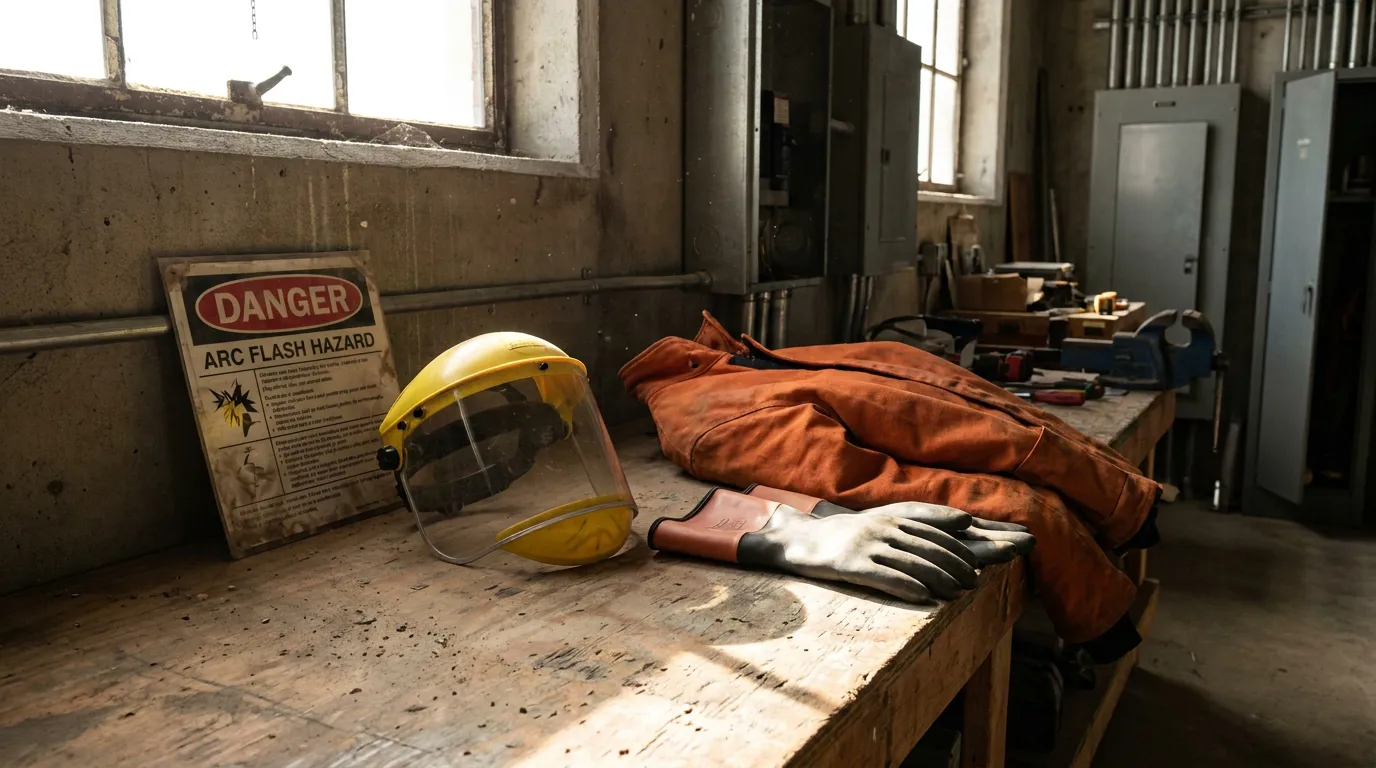
An arc flash generally injures through radiant heat and pressure rather than current passing along the body. In a traditional electrocution, current enters and exits the body, damaging tissue along its path. In an arc flash, the electrical fault ionizes the air and generates an intense burst of thermal energy that can ignite clothing, melt tools, and cause third-degree burns to exposed skin.
A related event, the arc blast, adds a concussive shockwave. The rapid expansion of superheated air and vaporized metal can throw a worker across a room, rupture eardrums, and drive molten debris into the eyes and face. Many severe cases involve both mechanisms at once, producing burns, orthopedic trauma, hearing loss, and traumatic brain injury in the same patient.
The Science Safety Standards Use to Measure the Danger
Federal guidance quantifies arc flash risk using incident energy, the thermal energy delivered to a surface at a given distance from an arc. Appendix E to OSHA’s electric power generation, transmission, and distribution standard (29 CFR 1910.269) outlines methods for estimating incident energy, including the Doughty/Neal/Floyd, Ralph Lee, and IEEE 1584 equations, which employers may use to select flame-resistant clothing and arc-rated PPE.
Safety standards also describe an arc flash boundary, the distance within which a person could receive a second-degree burn. Employers covered by the applicable standard are generally expected to assess those boundary distances and keep unprotected workers outside them. When an injured worker was standing inside that boundary in ordinary cotton work clothes, the arc flash boundary guidance can become useful evidence about what protective measures may have been appropriate. This federal standard applies by its terms to covered power generation, transmission, and distribution work, while much construction work instead falls under 29 C.F.R. Part 1926, including Subpart K. Which standard applies is fact-specific, and OSHA standards do not themselves create a private right of action in Illinois, though evidence of a violation may be admissible on the standard of care.
Common Causes of a Construction Site Electrical Accident
Most arc flash events trace back to identifiable failures in planning, equipment, or coordination, including:
- Energized work performed without a proper lockout/tagout or verified de-energization
- Missing, incorrect, or removed arc flash warning labels on panels and switchgear
- Defective breakers, damaged insulation, or improperly rated equipment
- Failure to provide arc-rated PPE, face shields, or insulated tools
- Poor coordination between trades, so one crew re-energizes a circuit another is working on
- Water intrusion, conductive dust, or dropped tools bridging energized parts
💡 Pro Tip: Photograph the panel, equipment labels, and your damaged clothing and tools as soon as safely possible. Equipment is often repaired or replaced within days, and that physical evidence can be difficult to recover later.
Injuries That Follow a Workplace Electrical Burn
Arc flash burns tend to be deep, disfiguring, and slow to heal. Third-degree burns to the hands, forearms, and face are common because those areas are frequently unprotected. Treatment often requires debridement, skin grafting, months of wound care, and prolonged rehabilitation, with high infection risk throughout.
Illinois statutory law recognizes electric shock as a defined category of product hazard. Under 430 ILCS 35/2-18, part of Illinois’ Uniform Hazardous Substances Act, an article may present an electrical hazard if, in normal use or when subjected to reasonably foreseeable damage or abuse, its design or manufacture may cause personal injury or illness by electric shock. That definition governs regulated consumer articles rather than construction site safety obligations, so it doesn’t itself create a claim for an injured worker; it’s cited here only to show Illinois law treats electric shock as a foreseeable, recognized danger.
Secondary consequences frequently outlast the burns themselves. Vision damage, hearing loss, nerve injury, chronic pain, and post-traumatic stress can permanently end a career in the trades. A full damages analysis generally accounts for future medical care, diminished earning capacity, and the reality that many burn survivors cannot return to field work.
Workers’ Compensation Benefits After an Arc Flash Injury Construction Worker Claim
Most injured Illinois construction workers may have a workers’ compensation claim against their employer, generally regardless of fault, if the injury arose out of and in the course of employment. Benefits generally include reasonable and necessary medical treatment, temporary disability payments while off work, and permanent disability compensation. The Illinois Workers’ Compensation Act governs these benefits, including a general requirement under 820 ILCS 305/6(c) that the employer be given notice of the accident, in most cases within 45 days.
Illinois workers’ compensation law provides for separate compensation for serious and permanent disfigurement in some circumstances. Under 820 ILCS 305/8(c), an employee may be entitled to compensation for serious and permanent disfigurement to the hand, head, face, neck, arm, leg below the knee, or the chest above the axillary line. That subsection also limits when disfigurement compensation may be awarded, including where compensation is payable under other provisions of Section 8 for the same injury. Because arc flash and arc blast events so often scar exactly those areas, this provision can be meaningful, though whether it applies and the amount awarded, if any, depend heavily on the specific facts and medical findings.
Deadlines That Can End a Claim
Filing deadlines differ depending on which type of claim you pursue, and courts generally interpret exceptions narrowly. Under 820 ILCS 305/6(d), an application for compensation generally must be filed with the Illinois Workers’ Compensation Commission within 3 years after the accident where no compensation has been paid, or within 2 years after the last payment, whichever is later. Where an accidental injury results in death, an application for death compensation may generally be filed within the same time frames.
Civil lawsuits generally follow a different clock. Under 735 ILCS 5/13-202, actions for injury to the person generally must be commenced within 2 years after the cause of action accrued. Civil actions not otherwise provided for, including many property damage claims, generally fall under a five-year period per 735 ILCS 5/13-205. Other deadlines can control instead, for example, shorter notice and limitations rules for claims against governmental entities, the wrongful death statute, and construction-related repose periods. Discovery rules and tolling doctrines may apply in limited circumstances, but they are not automatic, so reviewing Illinois filing deadlines early is generally safer than assuming an extension exists.
| Claim Type | General Deadline | Governing Statute |
|---|---|---|
| Workers’ comp (injury) | 3 years from accident, or 2 years from last payment, whichever is later | 820 ILCS 305/6(d) |
| Workers’ comp (death) | 3 years from death, or 2 years from last payment, whichever is later | 820 ILCS 305/6(d) |
| Personal injury lawsuit | 2 years from accrual | 735 ILCS 5/13-202 |
| Other civil actions not otherwise provided for | 5 years from accrual | 735 ILCS 5/13-205 |
Deadlines can shift based on the claimant’s age, legal disability, the identity of the defendant, and other fact-specific factors. This table is a general reference, not a substitute for case-specific analysis.
Third-Party Claims: The Route to Fuller Compensation
Workers’ compensation is generally the exclusive remedy against your employer, but it generally does not bar claims against other responsible parties. Under 820 ILCS 305/5(b) of the Workers’ Compensation Act, where an injury or death for which compensation is payable was caused under circumstances creating legal liability on the part of someone other than the employer, legal proceedings may be taken against that other person notwithstanding the employer’s payment of compensation. A parallel provision appears at 820 ILCS 310/5(b) of the Workers’ Occupational Diseases Act. Both provisions also give the employer reimbursement and lien rights in any third-party recovery.
On a multi-employer construction site, several parties may share responsibility for an arc flash hazard. Potential defendants can include a general contractor that failed to coordinate energized work, an electrical subcontractor whose crew re-energized a circuit, a property owner who concealed known wiring defects, an engineering firm that performed a faulty arc flash study, or a manufacturer whose breaker failed to interrupt the fault. Establishing liability generally requires proving a duty, a breach, and that the breach proximately caused the injury; in Illinois, whether a general contractor or owner owes a duty often turns on the degree of control it retained over the work.
Third-party claims may matter because they can reach damages workers’ compensation does not cover. Pain and suffering, disfigurement beyond statutory schedules, loss of normal life, and a spouse’s loss of consortium are generally unavailable in a comp claim but may be recoverable in a negligence action. Any recovery may be reduced by the employer’s workers’ compensation lien, and outcomes always depend on the specific evidence, the conduct of each defendant, and how comparative fault is assessed.
Building the Evidence Record Early
Safety violations are frequently the backbone of a third-party case. OSHA citations, the site safety plan, job hazard analyses, toolbox talk records, arc flash study documents, and equipment labeling may all help show what controlling parties knew, though admissibility and weight are decided case by case. Understanding the safety requirements for a construction site gives injured workers a framework for what may have been required before the flash occurred.
💡 Pro Tip: Report the injury to your employer in writing and request a copy of the incident report. Verbal notice is easy for an insurer to dispute months later.
Practical Steps After an Electrical Injury in Illinois
Getting immediate burn-center treatment can protect both your health and your claim. Arc flash injuries can look deceptively limited at first because thermal damage extends below the skin surface. Document every symptom, including vision changes, ringing in the ears, memory problems, and sleep disruption, since these may become significant elements of damages later.
Be cautious about recorded statements and early settlement offers. Insurance adjusters may contact you before the full extent of a workplace electrical burn is known, and an early resolution can foreclose future medical coverage. A firm handling arc flash injury construction worker lawyer matters can help you evaluate what is on the table before anything is signed.
Frequently Asked Questions
1. Can I file a lawsuit if I already accepted workers’ compensation benefits?
Possibly, depending on whether a party other than your employer bears responsibility. Under 820 ILCS 305/5(b), proceedings may be taken against a liable third party notwithstanding the employer’s payment of compensation. Your employer or its insurer will generally have a statutory lien against a third-party recovery, and how that lien is resolved depends on the facts.
2. How long do I have to file an arc flash injury lawsuit in Illinois?
Generally two years from when the cause of action accrued under 735 ILCS 5/13-202. Some claims may fall under the five-year catch-all in 735 ILCS 5/13-205, and other statutes may control specific claim types. Different, often shorter, rules can apply when a governmental entity is involved, so an early case review is prudent.
3. What if the arc flash was partly my fault?
Illinois applies modified comparative fault, so partial responsibility does not necessarily bar recovery. Under 735 ILCS 5/2-1116, damages are reduced in proportion to a plaintiff’s assigned fault, and recovery in most negligence actions is barred if that share is more than 50% of the proximate cause of the injury. Workers’ compensation benefits, by contrast, are generally available regardless of fault, subject to statutory exceptions such as intoxication provisions.
4. Does OSHA investigate every arc flash on a construction site?
Not necessarily, though fatalities and certain serious injuries, such as in-patient hospitalizations and amputations, trigger employer reporting obligations. An OSHA citation is generally not required to bring a civil claim, and the absence of a citation does not establish that a site was safe. Citations and inspection files can still serve as useful evidence, subject to evidentiary rules.
5. What compensation is available for permanent scarring?
Illinois workers’ compensation may provide separate disfigurement compensation under 820 ILCS 305/8(c) for serious and permanent disfigurement to areas including the hand, head, face, neck, and arm, where the statutory conditions are met. A third-party negligence claim may additionally allow recovery for pain, suffering, and loss of normal life. Values vary widely based on medical evidence and case-specific circumstances.
Protecting Your Recovery After a Serious Job Site Burn
An arc flash is one of the most destructive events that can occur on an Illinois construction site, and the legal response may require attention on two tracks at once. A workers’ compensation claim may secure medical care and wage replacement, while a third-party negligence action may reach the fuller damages a comp claim cannot provide. Both tracks generally carry firm statutory deadlines and notice requirements, and evidence about the panel, the arc flash study, the PPE, and the site safety program tends to disappear quickly. Every case is fact-dependent, and no outcome can be predicted in advance.
If an arc flash or arc blast has changed your life or your family’s future, the attorneys at Trapp & Geller are ready to listen. Reach the firm at (312) 368-1444 or schedule a case review to learn what deadlines may apply and what steps make sense in your circumstances.
Disclaimer: This content is for informational purposes only and is not legal advice. Every case is unique, and results may vary. Consult an attorney about your specific circumstances.