
How OSHA Violations Factor Into Illinois Construction Negligence Claims
Key Takeaways: In an Illinois construction case, an OSHA violation is usually not automatic proof of negligence, but it can be strong evidence that a contractor or other party failed to act with reasonable care. You generally still have to prove duty, causation and damages. Illinois treats violations as negligence or presumed negligence only under narrow statutes, such as 820 ILCS 310/3 for certain occupational disease claims and 220 ILCS 50/9 for underground utility damage. Workers’ compensation usually stops you from suing your own employer, but OSHA evidence can play a key role in third-party claims against general contractors, subcontractors, equipment makers or property owners. Comparative fault can lower your recovery, and it bars recovery entirely if you are more than 50% at fault. Liens can also affect how much you keep. Strict filing deadlines apply, so acting early may help you preserve evidence and protect your claim.
An OSHA violation is generally not automatic proof of negligence in an Illinois construction case, but it can be strong evidence that a contractor or other party failed to act safely. Illinois courts may let a jury consider a violated safety rule as evidence of how a reasonable party should have acted. You still have to tie that evidence to the facts, the defendant’s duty and the injury itself.
If you or a loved one was seriously hurt on a Chicago-area job site, the team at Trapp & Geller can review how safety violations may support your case. Call (312) 368-1444 or contact us now to talk about your options.
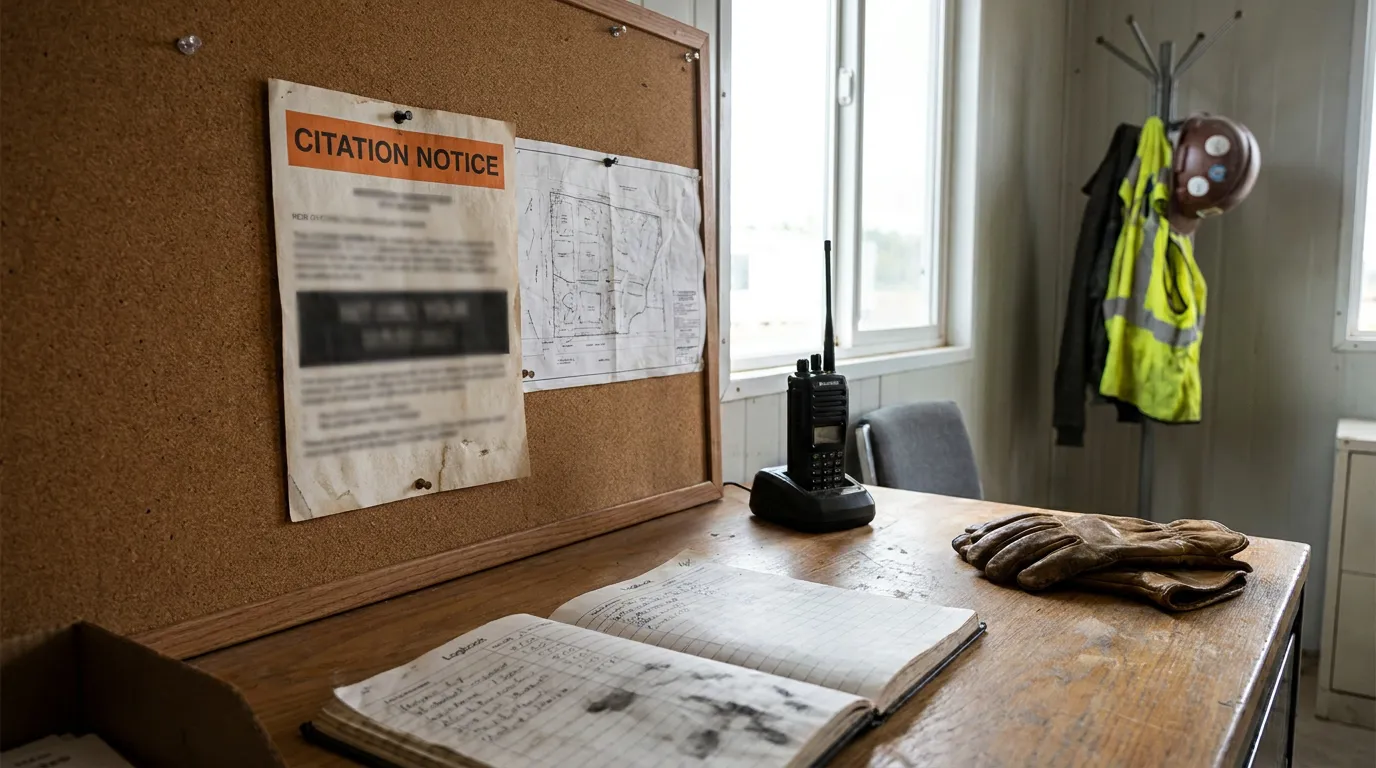
Why OSHA Violation Evidence of Negligence Construction Claims Matters
OSHA rules set minimum safety requirements for hazards like falls, scaffolding, trenching and electrical work. When a contractor ignores a fall protection or trench shoring rule, the violation may help show the jury what safe practice looked like and how far the defendant fell short.
Evidence is not the same as proof. In an Illinois negligence lawsuit, you must show that the defendant owed you a duty, breached it, and caused your injuries and damages. An OSHA violation may help prove breach. The defense may argue that the rule did not apply to its role on the site, or that the violation did not cause the accident. OSHA rules also do not, on their own, create a duty or give you the right to sue.
Duty Comes First
Before an OSHA violation matters, you need to show that the defendant owed you a duty of care. In Illinois, a general contractor or owner’s duty often depends on how much control it kept over the work, which courts analyze under Restatement (Second) of Torts § 414. On multi-employer sites, different companies may play different roles in creating or controlling a hazard. Our guide to the four OSHA employer roles explains how creating, exposing, correcting and controlling employers differ. Those roles concern OSHA citations, not civil liability, but they can help point to who may share responsibility.
Causation Links the Violation to Your Injury
A violation that played no part in your accident will not support liability. For example, a missing guardrail may matter a great deal in a fall case but little in a forklift crush case. Courts generally ask whether the rule was meant to protect people like you from the kind of injury you suffered.
When Illinois Law Treats a Violation as Negligence Per Se
Illinois has statutes that turn certain safety violations into negligence or presumed negligence, but they are narrow. Negligence per se generally means a violation counts as negligence itself, so you may not have to prove separately that the conduct was unreasonable. You still have to prove causation and damages.
The Occupational Diseases Act Provision
Under 820 ILCS 310/3, an employer’s violation of an effective rule issued under the Occupational Safety and Health Act or the Illinois Health and Safety Act counts as negligence. The same applies to any Illinois statute meant to protect employee health. This part of the Illinois Workers’ Occupational Diseases Act is limited, however. It applies only to a worker who gets an occupational disease on the job, and only where the employer is not subject to the Act and has not chosen to provide benefits under it. Most Illinois construction employers are covered, so this provision rarely applies.
In those cases, the employer also loses several standard defenses. The employer cannot argue that the worker assumed the risk or that a fellow worker was negligent, and cannot rely on the worker’s own negligence unless it was willful.
Underground Utility Damage Presumptions
Illinois’ underground utility damage law creates a presumption of negligence. Under 220 ILCS 50/9(a), an excavator that damages underground utility lines without following the Act is presumed negligent. Under 220 ILCS 50/9(b), utility owners or operators that fail to follow the Illinois underground utility law are presumed negligent for resulting damage to an excavator’s materials or equipment, as long as the excavator followed the Act. These presumptions address property damage, and the other side can rebut them.
Neither statute creates a general rule that every OSHA violation equals negligence. Outside these settings, OSHA evidence is usually one piece of a broader liability case.
Workers’ Compensation Versus Third-Party Construction Injury Claims
For most injured construction workers, the first source of benefits is workers’ compensation, which does not require proof of fault. Under the Illinois Workers’ Compensation Act, 820 ILCS 305, your employer generally cannot be sued for negligence in exchange for paying no-fault benefits. Exceptions are limited, such as when an employer meant to injure you. OSHA violations by your own employer therefore usually matter little in the workers’ compensation claim itself.
A third-party construction injury claim is different. If a general contractor, another subcontractor, an equipment maker or a property owner helped cause your injury, you may be able to sue that party for negligence or, for defective equipment, product liability. OSHA violation evidence can help show what the third party should have done. A third-party case may also allow recovery for damages workers’ compensation does not cover, such as pain and suffering. Your employer’s workers’ compensation carrier will usually have a lien on any third-party recovery under 820 ILCS 305/5(b).
💡 Pro Tip: Ask for a copy of any OSHA inspection file or citation tied to your accident. Employers can contest citations or get them reduced, so a lawyer can help you understand how much weight a citation may carry.
Deadlines That Can Affect Your Claim
Illinois sets different filing deadlines for different types of claims, and missing one can end your right to recover. Workers’ compensation deadlines apply to filing with the Illinois Workers’ Compensation Commission. Civil lawsuit deadlines are separate. For example, you must file most personal injury lawsuits within 2 years under 735 ILCS 5/13-202, and construction-related claims may also face the limits in 735 ILCS 5/13-214.
| Claim Type | Statute | General Deadline |
|---|---|---|
| Workers’ compensation injury | 820 ILCS 305/6(d) | 3 years after the accident if no compensation paid, or 2 years after the last payment, whichever is later |
| Radiological or asbestos injury | 820 ILCS 305/6(d) | 25 years after the last day in the hazardous environment |
| Workers’ comp death claim | 820 ILCS 305/6(d) | 3 years after death if no compensation paid, or 2 years after last payment |
| Occupational disease injury action | 820 ILCS 310/3 | 3 years after the last day of exposure |
| Occupational disease death action | 820 ILCS 310/3 | 1 year after death and within 5 years of last exposure (15 years for atomic radiation) |
Death recovery under 820 ILCS 310/3 is capped at $10,000. That cap applies only to the narrow occupational disease action described above, not to third-party wrongful death suits in general. Because the right deadline depends on your facts, have your case reviewed as early as possible.
How Comparative Fault and Liens Can Shape Your Recovery
Defendants often argue that the injured worker shares the blame, even when OSHA violations are clear. In a third-party negligence case, Illinois’ modified comparative fault rule under 735 ILCS 5/2-1116 reduces your damages by your share of fault and bars recovery if you are more than 50% at fault. Strong evidence of safety violations may help you push back when the defense tries to shift blame onto you.
Comparative fault can also affect what you owe health insurers or others who paid your medical bills. Under 770 ILCS 23/50, if your recovery is reduced by your share of fault, any claim to be repaid for medical expenses is generally reduced by the same share. That statute does not apply to workers’ compensation liens. 820 ILCS 305/5(b) governs your workers’ comp lien and generally reduces it by the employer’s share of attorney fees and costs.
Common evidence that may strengthen an OSHA-based negligence case includes:
- OSHA inspection reports, citations and settlement agreements
- Site safety plans, toolbox talk records and daily logs
- Photos and video of guardrails, scaffolds, trenches or wiring
- Witness statements from coworkers and foremen
- Contracts showing which company controlled site safety
💡 Pro Tip: Write down the names of every company on site the day you were hurt. Third-party claims often depend on who controlled the area or equipment involved.
Frequently Asked Questions
-
Does an OSHA citation guarantee I will win my case?
No. A citation can be strong evidence of a safety failure, but you must still prove duty, causation and damages.
-
Can I sue my employer for an OSHA violation?
Generally, no. The Illinois Workers’ Compensation Act usually limits you to workers’ compensation benefits against your employer, with narrow exceptions such as intentional injury. You may still have claims against third parties.
-
What is negligence per se?
It generally means a violation of a safety law counts as negligence itself. In Illinois, statutes like 820 ILCS 310/3 apply this idea in limited situations, but OSHA violations usually serve as evidence rather than automatic proof.
-
What if there was no OSHA inspection after my accident?
You may still use OSHA standards to show what safe practice required. A lawyer can gather site records, photos and testimony that may help show a violation even without a formal citation.
-
Will my own mistakes ruin my claim?
Not necessarily. Under 735 ILCS 5/2-1116, your damages are reduced by your share of fault, and recovery is barred only if you are more than 50% at fault.
Protecting Your Rights After a Job Site Injury
OSHA violations can be some of the most persuasive evidence in an Illinois construction accident case, but they rarely win a case alone. Illinois treats violations as negligence or presumed negligence only under specific statutes, such as 820 ILCS 310/3 and 220 ILCS 50/9. In most third-party cases, OSHA evidence may help prove breach, and you must still link it to duty, causation and damages. An experienced OSHA violation evidence of negligence construction lawyer can help you build that case.
Trapp & Geller is ready to help injured workers and families pursue full compensation for medical care, lost earnings and future losses. Reach out to Trapp & Geller by calling (312) 368-1444 or schedule your consultation today.
Disclaimer: This content is for informational purposes only and is not legal advice. Every case is unique, and results may vary. Consult an attorney about your specific circumstances.