
Linking Your Spinal Injury to the Crash in Illinois
Key Takeaways: To prove a car crash caused your herniated disc in Illinois, you generally need medical evidence tying the injury to the collision, such as prompt treatment records, a consistent patient history, MRI findings, and a treating physician’s opinion. Insurers often argue the disc problem comes from aging, an earlier injury, or a later event. Objective imaging, crash evidence, and proof that a pre-existing condition worsened may answer these arguments. Under the Health Care Services Lien Act, Illinois generally caps the combined liens of health care professionals and providers at 40% of your recovery. Other reimbursement claims, such as those from health plans or government programs, may follow different rules. You generally have two years to file a personal injury lawsuit under 735 ILCS 5/13-202, though shorter deadlines may apply in some cases.
To prove a car crash caused your herniated disc in Illinois, you generally need medical evidence that connects the injury to the collision. That evidence often includes prompt treatment records, MRI findings, a treating physician’s opinion, and proof of how the crash forces could have damaged your spine. Insurers often argue that a herniated disc after car accident claims comes from aging, a prior injury, or a later event. Knowing what evidence matters, and when to gather it, can help protect your claim.
If you are dealing with back or neck pain, medical bills, and insurance pushback after a collision, you do not have to sort it out alone. The team at Trapp & Geller helps injured Illinois residents build the evidence needed to show what the crash did to their bodies. Call (312) 368-1444 or contact us now to talk about your situation.
Why Causation Becomes the Central Fight in Disc Injury Claims
In an Illinois negligence claim, an injured person generally must show that the other party owed a duty of care and breached it, that the breach caused the injury, and that the injury led to damages. Liability may be easier to show in a rear-end collision, though it is not automatic. Under Illinois’s modified comparative fault rule (735 ILCS 5/2-1116), your recovery may be reduced by your share of fault, and it is barred if you are more than 50% at fault. Causation is often harder to prove, since herniated discs can also come from degeneration, which tends to show up on imaging as people age.
Insurers know this and may use it to reduce or deny payment. An adjuster might cite "pre-existing degenerative changes" on your MRI or point to a gap in treatment. These arguments do not necessarily end a claim, but they make strong medical causation evidence essential.
What Insurers Commonly Argue
Defense arguments in disc cases usually follow a familiar pattern:
- The disc condition existed before the crash and is degenerative
- The collision was too minor to cause a spinal injury
- A delay in treatment means something else caused the pain
- A later event, such as lifting or a fall, caused the herniation
- Your symptoms are exaggerated or not supported by objective findings
Depending on the circumstances, each of these arguments may be answered with the right evidence.
Building Medical Proof for a Herniated Disc After Car Accident Claims
The strongest spinal injury proof usually starts with what you tell your doctor and when. Your first medical visits create a record the other side may later review. Reporting that your pain began with the collision puts that connection in writing from the beginning.
The Patient History You Give Matters
The records you create at the doctor’s office may play a direct role in proving causation. The at-fault driver’s insurer or attorney may obtain your records through a medical authorization you sign or, once a lawsuit is filed, through discovery or a subpoena. Separately, under 770 ILCS 23/25(a), a provider claiming a lien under the Illinois Health Care Services Lien Act must respond to a written request with statements about your injuries and treatment. Under 770 ILCS 23/25(b), a provider that fails to do so may risk the enforceability of its lien.
💡 Pro Tip: Be specific with every provider. Saying "my lower back started hurting after I was rear-ended on the Kennedy" is far more useful than "my back hurts." Also tell them honestly about any prior back problems, since a documented change from your baseline can help show aggravation.
MRI Findings and Objective Evidence
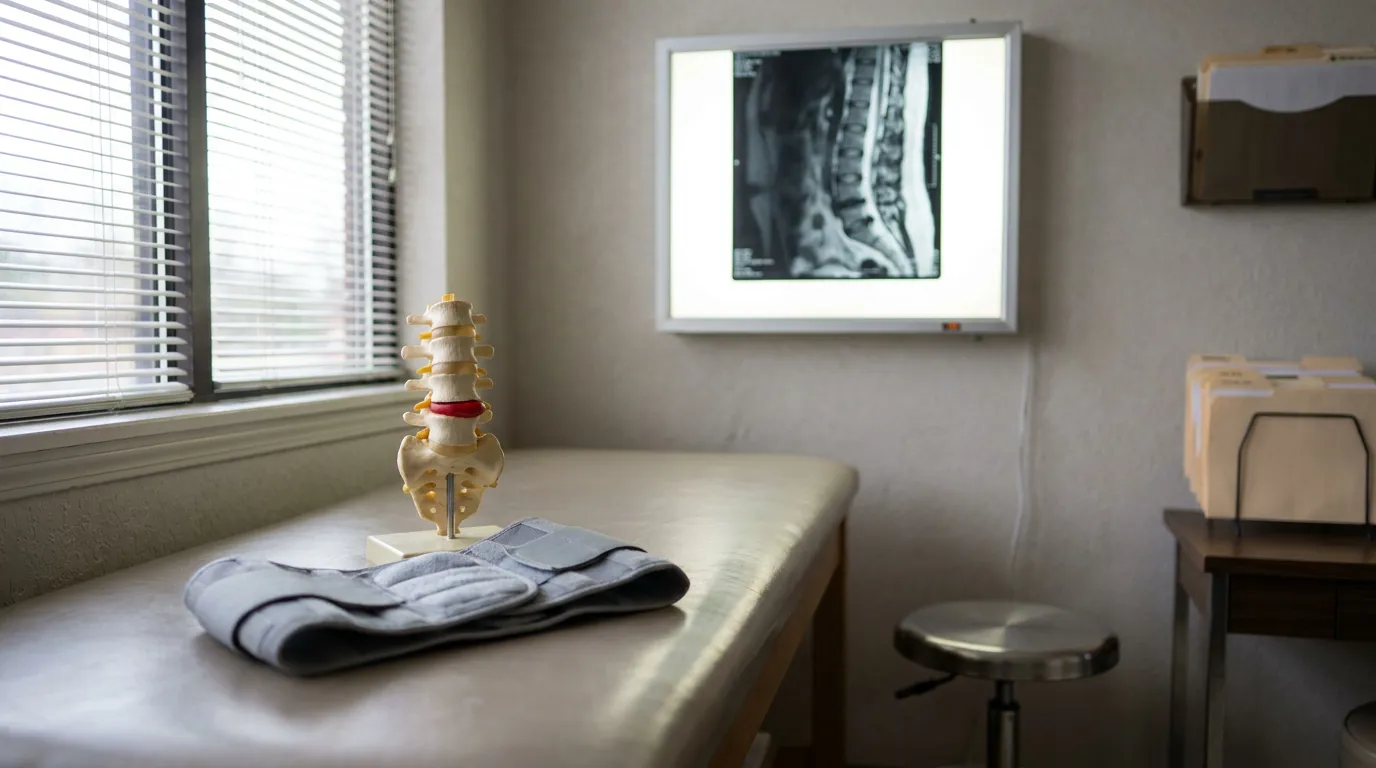
MRI findings in a car accident case often serve as the objective anchor of a disc claim. An MRI can show the location and size of a herniation and whether it presses on a nerve. When symptoms such as radiating pain, numbness, or weakness match the level shown on imaging, that consistency can support causation. An MRI alone usually cannot show when a herniation happened, so it is typically read together with your history and exam findings.
Comparing old and new imaging can be especially helpful. If you had a spine MRI before the crash, a later scan showing a new or worsened herniation may help show the collision caused or aggravated the condition.
The Treating Physician’s Opinion
A treating physician’s opinion often carries significant weight because that doctor has examined you over time. Your doctor may be asked whether, to a reasonable degree of medical certainty, the crash caused or aggravated your herniated disc. The defense may offer its own medical expert to challenge that opinion.
Physicians can also address the "pre-existing condition" defense directly. Illinois law generally allows recovery when a crash aggravates an earlier condition, though damages are generally limited to the harm caused by the aggravation. A doctor’s explanation that a previously symptom-free spine became painful after the collision can help support that theory.
Showing the Mechanism of Injury
The mechanism of injury describes how the forces in the crash could have damaged your spine. Sudden acceleration, twisting, or compression can place heavy stress on spinal discs. Explaining this connection can help counter the claim that a "minor" crash could not cause real harm.
Evidence of the crash itself often supports the medical evidence. Photos of vehicle damage, repair estimates, police reports, witness statements, and surveillance or dashcam video may all help. Vehicle event data or phone records may also show speed, braking, or distraction. Some of this evidence can disappear quickly, so early preservation matters. Our guide on steps to take after a crash covers ways to protect your claim early.
How Medical Liens Affect a Herniated Disc Lawsuit
Disc treatment can be expensive, and providers who treat you may claim a lien on your recovery. Under 770 ILCS 23/10(a), doctors, hospitals, and other providers who treat an injured person may have a lien on the claim for their reasonable charges. This does not apply to services covered by workers’ compensation. The Health Care Services Lien Act also sets limits that may help protect your recovery. These caps apply to provider liens under the Act and generally do not limit separate reimbursement claims, such as those from Medicare, Medicaid, or certain health plans.
| Rule | What It Means | Source |
|---|---|---|
| Total lien cap | All liens under the Act together generally cannot exceed 40% of the verdict, judgment, award, settlement, or compromise | 770 ILCS 23/10(a) |
| Single category cap | No single licensed category of provider can receive more than one-third of the recovery | 770 ILCS 23/10(c) |
| Split at 40% | If liens reach or exceed 40%, health care professionals as a group and health care providers as a group are each limited to 20% | 770 ILCS 23/10(c) |
| Notice contents | Must include your name and address, injury date, provider information, and the allegedly liable party | 770 ILCS 23/10(b) |
| Service method | Registered or certified mail, or in person, on you and the party the claim is against | 770 ILCS 23/10(b) |
| Attachment | Lien attaches to any verdict, judgment, award, settlement, or compromise after notice | 770 ILCS 23/20 |
These caps can matter a great deal when MRIs, injections, or surgery lead to large bills. Under 770 ILCS 23/15, a settlement or judgment generally cannot be paid until written notice has been given to each provider that served a lien notice.
The court can resolve lien disputes when needed. Under 770 ILCS 23/30, the injured person or a provider can ask the circuit court to decide everyone’s rights and enforce the liens. Health plan reimbursement claims are handled differently. Under 770 ILCS 23/50, those claims may be reduced by a share of attorney fees and costs, and certain federally governed plans may not be subject to that section.
Filing Deadlines for a Herniated Disc Car Accident Illinois Claim
Illinois generally gives injured people two years to file a personal injury lawsuit. Under 735 ILCS 5/13-202, the Illinois statute of limitations for personal injury actions, including disc injuries from car crashes, is generally two years from the date of injury. Missing this deadline may bar your claim entirely.
Some exceptions may extend or change this deadline, but courts often interpret them narrowly. For example, the deadline for an injured minor generally does not begin to run until the minor turns 18. Claims against local government entities are generally subject to a one-year limitations period under 745 ILCS 10/8-101. Claims against the Chicago Transit Authority are also generally subject to a one-year deadline to file a lawsuit, a shorter period than the standard two-year personal injury statute of limitations, though the separate written pre-suit notice requirement that once applied to such claims was repealed effective June 1, 2009.
Working With Counsel on Your Spinal Injury Case
An experienced legal team can help gather records, coordinate physician opinions, and respond to insurer arguments. A herniated disc lawsuit lawyer can review your records, request imaging comparisons, and address lien issues before settlement. Every case is different, and results depend on the specific facts.
Frequently Asked Questions
1. Can I recover if I had back problems before the crash?
Possibly. Illinois law generally allows recovery when a crash aggravates a pre-existing condition, though damages are generally limited to the worsening the crash caused.
2. What if I did not see a doctor right away?
A delay does not automatically end a claim, but insurers often use it to question causation. Getting evaluated as soon as possible and explaining the delay honestly may help.
3. Is an MRI required to prove a herniated disc?
Not in every case, but MRI findings are often the most persuasive objective evidence. Your physician may also rely on exams, nerve testing, and symptom history.
4. How long do I have to file a lawsuit in Illinois?
Under 735 ILCS 5/13-202, the deadline is generally two years from the injury. Claims against local government entities generally have a one-year deadline and may require earlier notice.
5. Will medical liens take my whole settlement?
Under 770 ILCS 23/10, provider liens under the Act together generally cannot exceed 40% of the recovery. Other reimbursement claims may follow different rules. Lien disputes can be brought to the circuit court under 770 ILCS 23/30.
Protecting Your Right to Full Compensation
Proving a herniated disc after car accident injuries usually depends on consistent medical records, objective imaging, a supportive treating physician’s opinion, and evidence of how the crash happened. Illinois law also sets important rules on comparative fault, medical liens, and filing deadlines that can affect what you recover. Acting early to preserve evidence and document your symptoms may help strengthen your position.
If a collision left you with a spinal injury, the team at Trapp & Geller is ready to review your situation and explain your options. Call (312) 368-1444 or schedule your consultation today to start building your claim.
Disclaimer: This content is for informational purposes only and is not legal advice. Every case is unique, and results may vary. Consult an attorney about your specific circumstances.